Understanding Power Exchange in Modern Relationships
What power exchange is, how it works in D/s dynamics, and what research says about its effects on couples.

Quick answer
Power exchange is a relationship structure in which partners consensually negotiate an asymmetry of authority: one partner (the dominant) leads, while the other (the submissive) serves. Unlike casual play, a power exchange dynamic is ongoing, often governing daily routines, communication protocols, and accountability. Research suggests the practice is more common than assumed: a study of a representative Belgian sample found that approximately 47% had performed at least one BDSM-related activity (Holvoet et al., 2017, Journal of Sexual Medicine).
What Makes Power Exchange Different
At its core, power exchange is about consensual structure. One partner takes on leadership responsibilities, while the other finds fulfillment in service and surrender. This isn't about inequality. It's about complementary roles that each partner actively chooses. A study comparing BDSM practitioners with a non-BDSM control group found that practitioners scored higher on subjective wellbeing and lower on attachment anxiety (Wismeijer & van Assen, 2013, Journal of Sexual Medicine).
Tip
The foundation of any healthy power exchange relationship is enthusiastic consent from both partners. Structure without consent is control; structure with consent is devotion.
The Three Pillars
Every successful D/s dynamic rests on three interconnected pillars:
- Communication: Regular check-ins, honest feedback, and clear expectations
- Consistency: Following through on agreements, rituals, and protocols
- Care: Prioritizing each other's wellbeing above all else
To understand how these pillars shape a specific relationship type, see our guide to what a D/s dynamic is. For a practical step-by-step approach to starting, see power exchange for couples.
Building Trust Through Structure
Many couples find that explicit structure actually creates more intimacy, not less. When expectations are clear, both partners can relax into their roles without anxiety or guesswork.
Research supports this: Sagarin et al. (2009, Archives of Sexual Behavior) measured hormonal changes and increased relationship closeness during consensual power exchange scenes, suggesting that structured D/s interaction can have genuine psychological effects for both partners.
Starting Small
If you're new to power exchange, resist the urge to implement everything at once. Start with:
- One daily ritual: A simple check-in or gesture of devotion
- Clear communication protocols: How and when to express needs
- Regular evaluation: Weekly conversations about what's working
Rituals
Create recurring rituals that strengthen your bond. Morning check-ins, evening protocols, and more.
The Role of Technology
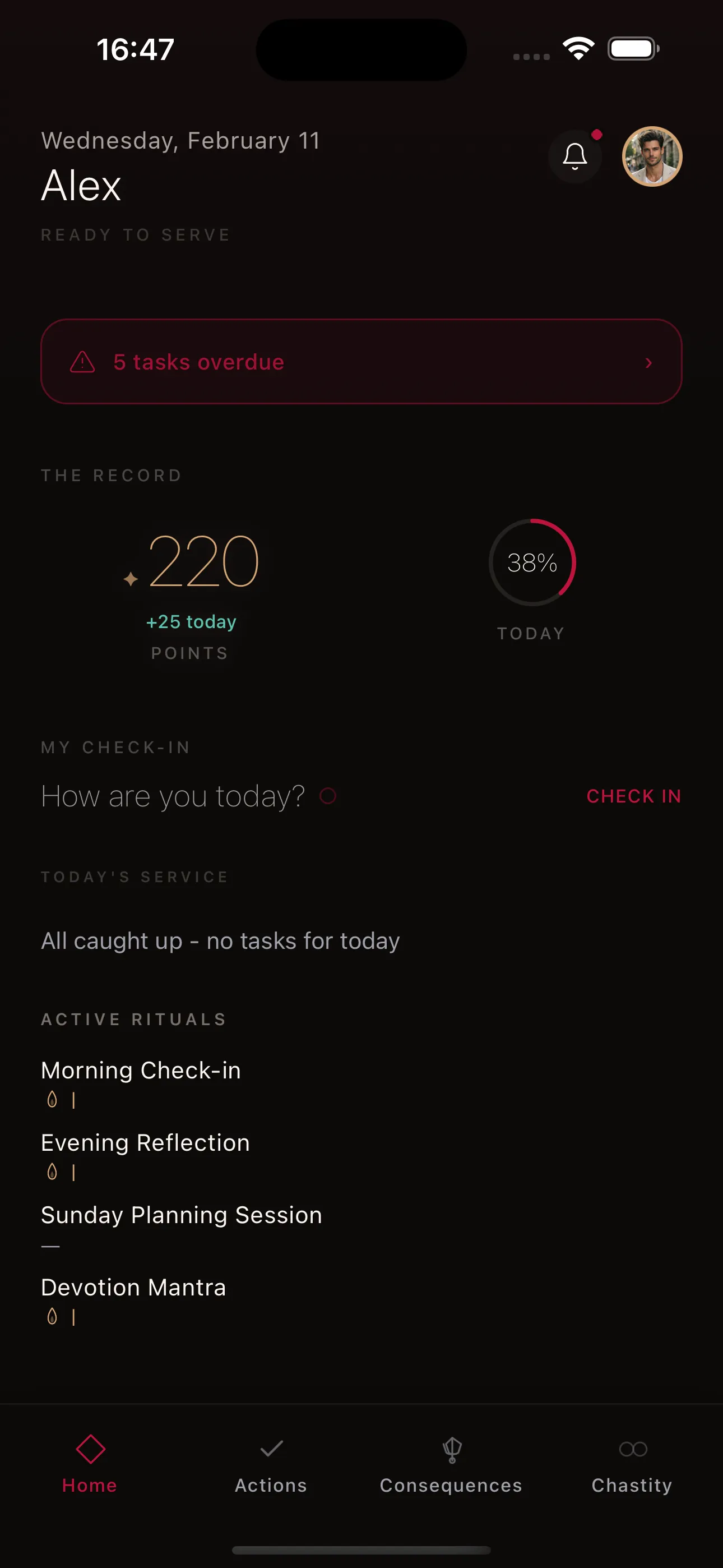
Modern tools can help maintain consistency when life gets busy. Rather than replacing human connection, well-designed apps serve as a scaffold for your dynamic.
Info
Technology works best when it reduces friction around logistics, freeing you to focus on the emotional core of your relationship.
Common Misconceptions
"Power exchange is 24/7 or nothing"
Many successful couples practice contextual dynamics, with power exchange during specific times or activities, while maintaining equality in other areas. There's no single "right" way to structure your relationship. Femdom, Female-Led Relationships, and various types of BDSM all represent different expressions of power exchange.
"The dominant is always in control"
In reality, the submissive holds significant power through their consent. Good dominants actively serve their submissive's growth and wellbeing. The flow of power is reciprocal.
"Structure kills spontaneity"
Paradoxically, having clear frameworks often creates more freedom to be spontaneous within those boundaries. When both partners understand the rules, creative play becomes safer and more fulfilling.
Practical Next Steps
Ready to explore power exchange in your own relationship? Consider these starting points:
- Have the conversation: Share this article and discuss what resonates
- Define one simple ritual: Something achievable that builds consistency -- see our guide to daily rituals
- Formalize your agreement: Even a simple contract creates clarity
- Set a review date: Commit to evaluating how it's working in 2-4 weeks
- Learn the language: Our BDSM terms glossary covers the vocabulary you'll encounter
- Develop your role: Whether dominant or submissive, intentional growth matters -- see our submissive training guide or explore the BDSM lifestyle
Tasks
Assign daily, weekly, or one-time tasks with point values. Track completion and build consistency.
Frequently Asked Questions
What is power exchange in BDSM?
Power exchange is a consensual arrangement where authority flows from one partner (the submissive) to another (the dominant). It can be limited to specific areas (household management, scheduling) or encompass broad aspects of daily life. The "exchange" is intentional: the submissive gives authority, and the dominant accepts the responsibility of wielding it within negotiated boundaries.
Is power exchange the same as D/s?
Power exchange is the broader concept; D/s (Dominance/submission) is the most common expression of it. All D/s relationships involve power exchange, but power exchange can also occur in contexts not typically labeled D/s -- such as a Female Led Relationship focused purely on household authority, or a service-oriented dynamic without D/s protocols. The terminology overlaps significantly.
Can power exchange be equal?
Power exchange involves a consensual imbalance of authority -- that's the defining feature. However, "unequal authority" doesn't mean "unequal value." Both partners have equal worth, equal voice in defining the structure, and equal ability to renegotiate or exit. The dominant leads within a framework both partners built together. Think of it as asymmetric by design, not by worth.
How do you negotiate a power exchange dynamic?
Start by discussing: what areas of life the exchange covers, what specific authorities the dominant holds, what limits exist (hard limits and soft limits), how decisions are reviewed, what safe words or exit protocols exist, and when you'll formally reassess the agreement. Write it down -- even informally. Revisit the negotiation regularly as the dynamic evolves.
What does power exchange feel like?
For submissives, it's often described as relief -- the mental load of certain decisions lifts, replaced by clarity and purpose. For dominants, it's described as focused responsibility -- gratifying but requiring consistent attention. Both partners commonly report feeling more connected, more present, and more intentional about their relationship than in unstructured partnerships.
Power exchange isn't about one partner dominating another. It's about two people consciously choosing how they want to relate. When done with care, communication, and consent, it can be one of the most fulfilling relationship structures available.
Key takeaways
- Power exchange is a consensually negotiated asymmetry of authority in which one partner leads and the other serves.
- It is ongoing rather than occasional, often governing daily routines, communication protocols, and accountability.
- The three pillars of a working dynamic are communication, consistency, and care.
- A study of a representative Belgian sample found that roughly 47% had performed at least one BDSM-related activity (Holvoet et al., 2017).
- Starting with one daily ritual and clear communication protocols works better than implementing everything at once.
Note
Every dynamic is unique. What matters isn't following any particular script, but finding what brings both partners closer together.
Ready to structure your dynamic?
Tasks, rituals, contracts, and accountability — built for real D/s couples.


Free to start · No credit card required


