Submissive Training: A Complete Guide for D/s Couples
A practical submissive training guide for D/s couples. Learn how to build task progression, daily rituals, and accountability.

Submissive training is the process of building structure, consistency, and accountability within a D/s dynamic. It's not about breaking someone down; it's about building someone up through clear expectations, progressive challenge, and mutual investment.
Whether you're a dominant creating a training framework or a submissive seeking structure, this guide covers the practical foundations that make training sustainable and fulfilling. For broader training principles that apply to both sides of the dynamic, see our BDSM training guide.
What Submissive Training Actually Is
Training is how a power exchange dynamic moves from concept to daily practice. It's the bridge between "we want a D/s relationship" and "we live one."
At its core, training involves:
- Clear expectations: Both partners know what's required
- Progressive difficulty: Start simple, build complexity over time
- Consistent accountability: Actions have consequences, good and bad
- Regular evaluation: What's working? What needs adjustment?
Tip
Training is a collaborative process. The dominant sets the framework, but the submissive's feedback shapes how it evolves. Communication is not optional; it's the foundation.
The Training Framework
Phase 1: Foundation (Weeks 1–2)
Start with one or two simple daily rituals. The goal isn't difficulty; it's building the habit of structure.
Example rituals (for more ideas, see our guide to daily rituals):
- Morning greeting text at a set time
- Evening gratitude reflection (3 things)
- A simple daily check-in on mood and energy
Rituals
Create recurring rituals that strengthen your bond. Morning check-ins, evening protocols, and more.
These rituals establish a baseline. They teach consistency without overwhelming either partner. A dominant learns to monitor; a submissive learns to report.
Phase 2: Tasks and Direction (Weeks 3–4)
Once rituals are consistent, introduce assigned tasks. Tasks differ from rituals: they have specific deadlines, varying difficulty, and clear completion criteria.
Start with low-stakes tasks:
- Complete a specific household chore by a set time
- Research a topic and share a summary
- Prepare something for your dominant
Tasks
Assign daily, weekly, or one-time tasks with point values. Track completion and build consistency.
Gradually increase complexity. Add photo proof requirements for tasks that benefit from verification. Introduce point values so effort is tracked and rewarded. For task management details, see our tasks feature guide.
Phase 3: Accountability (Weeks 5–8)
With rituals and tasks established, introduce consequences for missed expectations. This isn't about punishment for its own sake; it's about demonstrating that the structure matters.
Graduated accountability:
- Gentle reminder: First missed ritual gets a conversation
- Minor consequence: Second miss triggers a short timer task (writing lines, corner time)
- Significant consequence: Repeated misses escalate to restrictions or extended tasks
Rewards & Consequences
Motivate with meaningful rewards and fair consequences. Balance positive and corrective feedback.
The key is consistency. Consequences that are threatened but never enforced erode trust faster than having no consequences at all. For a deeper look at how consequence systems work, see our consequences feature guide.
Phase 4: Protocols and Depth (Months 2+)
As the dynamic matures, add protocols: more nuanced behaviors that reflect the unique character of your relationship.
Examples:
- Communication protocols (how to address each other, when to ask permission)
- Service protocols (specific ways to provide daily service)
- Reporting protocols (weekly written reflections, daily journals)
This is where training becomes personal. No two dynamics look alike at this stage. Some couples introduce physical protocols -- see our guide to submissive positions for common postures used in D/s dynamics. Different types of submissives thrive under different protocol styles, so adapt to what resonates with your dynamic.
Building a Training Plan
A good training plan has four components:
- Defined expectations: What does success look like for each task or ritual?
- Measurable progress: Points, streaks, completion rates
- Regular review: Weekly check-ins to discuss what's working
- Written agreement: A contract that formalizes expectations for both partners -- see our FLR contract guide for a template and writing tips
Contracts
Document agreements, limits, and expectations. Review and renew together.
Info
Kneel tracks streaks, points, and completion history automatically, giving both partners data to discuss during reviews rather than relying on memory.
How to Train Someone to Be Submissive (for Dominants)
The phases above describe the plan. This section is the dominant's side of it: how to train someone to be submissive when you are the one holding the structure. Six steps, in order. Each one depends on the one before it.
- Agree on what "submissive" means for the two of you: Before any task, write down the areas the dynamic covers and the areas it does not. "You handle the kitchen and send a morning message" is trainable. "Be more submissive" is not. Limits and a way to pause go in the same conversation. See the types of submissives post if you are not sure what kind of structure your partner responds to.
- Give one clear instruction and check it: Pick a single daily ritual. State the time, the format, and what "done" looks like. Then check it every day. If you do not check, you have trained them that instructions are optional. This is the whole method in miniature: instruct, verify, respond.
- Respond to every result, both ways: Completed on time gets acknowledged, in words, the same day. Missed gets a known response, agreed in advance. Praise is not optional. A submissive who only hears from you when something goes wrong learns to avoid you, not to serve you.
- Add difficulty only after consistency: Two weeks of a ritual done without reminders is the signal to add tasks with deadlines and proof. Two weeks of tasks done on time is the signal to add consequences. Adding before the signal is the most common reason training collapses.
- Read their state, not just their log: A daily mood check-in tells you whether the structure is building someone up or wearing them down. Low mood plus perfect completion is a warning, not a win. Adjust the pace before you adjust the rules.
- Review weekly and change one thing: Ten minutes on a fixed day. What worked, what was missed, what changes. One change at a time, so you can see what caused what. Write the change into the rules or the contract so it survives the week.
Training someone to be submissive is mostly the dominant's discipline: consistent checking, consistent response, and patience with the pace. The submissive's part is showing up. Yours is noticing that they did.
Common Training Mistakes
Starting Too Ambitious
The number one reason training fails is trying to do too much too fast. Three rituals, five tasks, and a full protocol system in week one will burn out both partners.
Better approach: One ritual for two weeks. Add a second only when the first is consistent.
Inconsistent Follow-Through
If a dominant assigns tasks but doesn't review completions, the submissive learns that compliance is optional. Training requires the dominant to be as disciplined as the submissive.
Ignoring Feedback
Training isn't a monologue. Regular check-ins where the submissive can honestly share what's too easy, too hard, or not working are essential. A daily check-in creates space for this.
Confusing Training with Control
Healthy training empowers the submissive. If training consistently makes either partner feel worse, something needs to change. The goal is growth, not diminishment.
Training Tools
Technology can reduce the mental load of maintaining structure. Instead of remembering every task deadline and ritual schedule, a dedicated dom sub app handles the logistics so both partners can focus on the relationship.
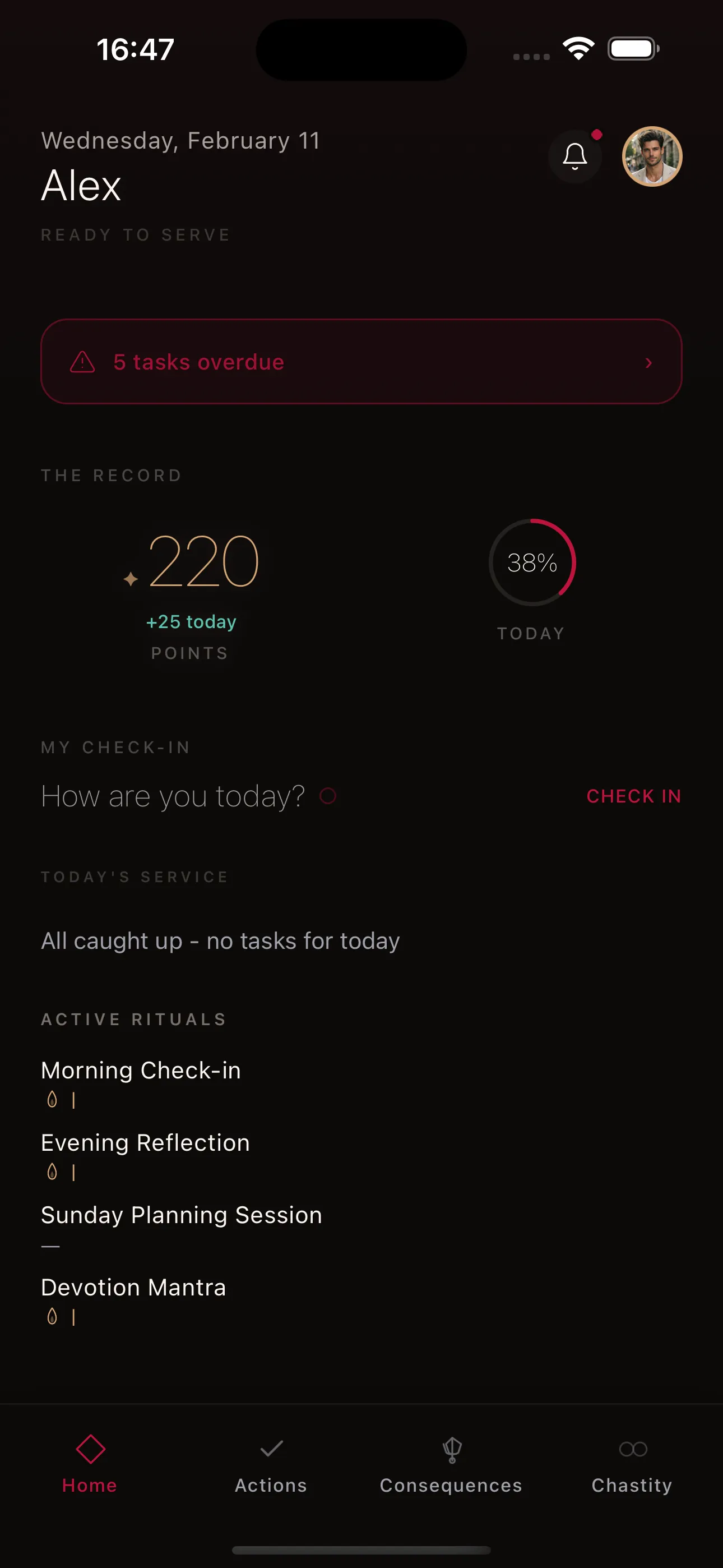
What to look for in a training tool:
- Ritual scheduling with streak tracking
- Task assignments with due dates and proof requirements
- Point systems that track effort over time
- Consequence management for accountability
- Contract templates for formalizing agreements
Getting Started
- Talk about it: Discuss what training means to both of you
- Start with one ritual: Something simple, daily, and achievable
- Track it: Use an app or journal to maintain accountability
- Review weekly: Adjust based on real experience
- Formalize gradually: Add complexity only when the foundation is solid
Submissive training is a journey, not a destination. The couples who sustain it long-term are the ones who prioritize communication, start small, and build progressively. Structure creates freedom, and good training creates the structure. If your dynamic includes a Female Led Relationship, see our guide on FLR training and discipline for role-specific approaches.
Frequently Asked Questions
How long does submissive training take?
There's no fixed timeline. Most couples spend 2-4 weeks on foundational rituals before adding tasks, and another 4-8 weeks building accountability systems. Training is ongoing -- it evolves with the dynamic rather than reaching a finish line.
Can you train without a dominant partner?
Self-directed training has limits. You can build habits and practice rituals independently, but the accountability loop -- where a dominant reviews, reinforces, and corrects -- is what makes training sustainable. A dom sub app can help bridge the gap for long-distance dynamics.
What if the submissive resists training?
Resistance is information, not defiance. It usually signals that something is off: the pace is too fast, the tasks feel meaningless, or there's unresolved tension. Schedule an honest conversation before assuming the worst.
How do you train someone to be submissive?
Agree on what submission covers for the two of you, then give one clear daily instruction with a set time and a defined "done." Check it every day and respond to every result: acknowledge completions in words, apply an agreed response to misses. Add tasks, proof, and consequences only after two weeks of consistency at each step. Use a daily mood check-in to read how your partner is doing, and review weekly, changing one thing at a time. The dominant's consistency is what trains; the rules are just the material.
Is submissive training only for beginners?
No. Established dynamics use training to add new protocols, deepen existing ones, or restart after a break. Training is the ongoing practice of maintaining structure, not a one-time onboarding process.
How do you handle submissive training in a long-distance relationship?
Digital tools are essential. Scheduled rituals with automated reminders, task assignments with photo proof, daily mood check-ins, and video call reviews create structure that survives distance. The logistics are harder, but the principles are identical.
Note
Looking for a tool to support your training? Kneel is purpose-built for D/s dynamics, with tasks, rituals, consequences, and contracts in one app. Learn more about features.
Ready to structure your dynamic?
Tasks, rituals, contracts, and accountability — built for real D/s couples.


Free to start · No credit card required


